AI, Session
NeurIPS 2025 Workshop
Gyges Labs hosts NeurIPS Workshop Panel on Open-World Agents
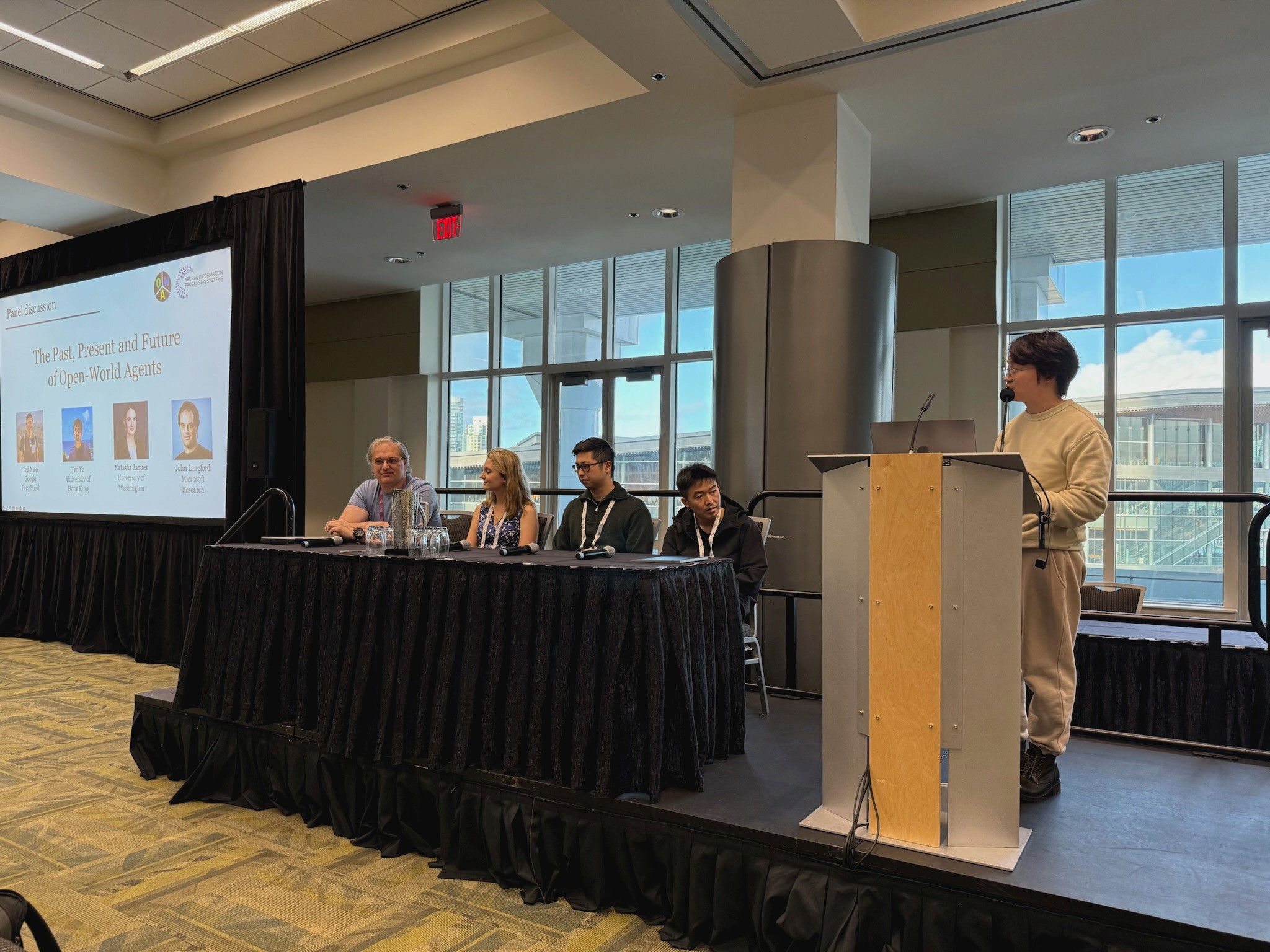
At NeurIPS 2025, Gyges Labs Chief Scientist Siyuan Qi served as panel chair for the Open-World Agents Workshop (OWA-2024), bringing together leading researchers and industry experts to discuss the past, present, and future of open-world AI agents.
The workshop—organized by researchers from HKU, University of Washington, and Microsoft Research—focused on one of the most pressing challenges in modern AI: building agents that can operate, adapt, and reason in unbounded, dynamic real-world environments.
The panel featured:
Yee Whye Teh, University of Hong Kong
Natalia Ariza, University of Washington
John Langford, Microsoft Research
Additional researchers and practitioners from academia and industry
Defining the Next Frontier of Agent Intelligence
As the panel chair, Qi opened the discussion by highlighting the importance of open-world robustness—a core requirement for any agent expected to operate outside of narrow, fully-specified tasks.
Qi emphasized that unlike closed-world benchmarks, real-world scenarios require continuous perception, adaptive planning, and the ability to generalize to never-seen states.
“Most real environments are open, uncertain, and constantly shifting,” Qi noted. “If we want agents to truly assist humans, they must reason at multiple timescales, adapt to novel situations, and operate proactively—not reactively.”
Key Topics Explored in the Panel
The discussion engaged a broad audience of researchers interested in bridging reinforcement learning, large language models, robotics, and multimodal reasoning. Key themes included:
1. Reasoning Beyond Next-Token Prediction
How LLM agents can incorporate planning, reflection, and iterative self-correction to operate in complex environments.
2. Continual Learning and Open-World Adaptation
Mechanisms that allow agents to learn continually without catastrophic forgetting, especially when deployed in long-running real-world tasks.
3. Tool Use and Environment Interaction
How agents should integrate APIs, external tools, and physical sensors to extend their cognitive and operational abilities.
4. Evaluation in Open-World Settings
Why traditional datasets fail to capture real-world unpredictability, and the need for new benchmarks that reflect evolving goals, incomplete information, and multi-agent dynamics.
5. Safety and Alignment in Open-World Agents
Strategies to ensure robustness, prevent error amplification, and align agent decisions with human values during autonomous operation.
Industry–Academia Momentum Toward Open-World AI
As someone leading the development of proactive, real-time AI agents for wearable computing at Gyges Labs, Qi emphasized the practical importance of open-world agent research.
He noted that the challenges discussed at the workshop directly influence the next generation of ambient intelligence—agents that can accompany users throughout their day, understand context continuously, and take initiative without explicit instructions.
Driving the Future of Real-World AI Agents
The Open-World Agents Workshop drew strong participation and became a focal point for discussions about the next era of agentic AI. Qi’s role as panel chair highlights Gyges Labs’ ongoing contributions to both cutting-edge research and real-world AI deployment.
Gyges Labs remains committed to pushing the frontier of agent intelligence and translating advances from the academic community into practical systems for wearable, real-time, proactive AI.